How to Monitor Elderly Parents Living Alone (Without Cameras)

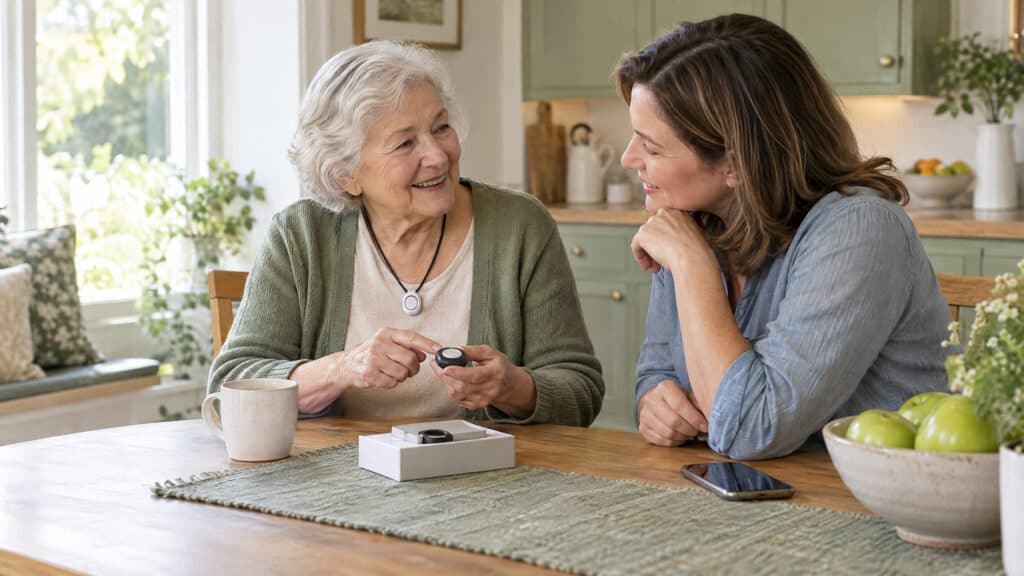
An older woman and her adult child discuss a wearable safety button at home.

Worrying about a parent who lives alone often starts with one missed phone call. Here is how to monitor elderly parents living alone without cameras: pair a daily check-in from a real person with a safety tool that fits how your parent lives. That tool might be a medical alert button or sensors that notice sounds and movement. Let your parent help choose.

This guide compares the most popular options and the practical ways families combine them. We offer some of these care services ourselves, so we also tell you where they are not the right fit. Honest trade-offs matter here.

Many adult children want two things at once: to know their parent is safe, and to respect their parent’s independent living. The good news is that remote monitoring no longer means a camera in every room. Modern technology gives families peace of mind with far less intrusion.

How to monitor elderly parents living alone: start with a conversation

The first step is an open conversation with your parent about what worries you and what they are willing to accept. The National Institute on Aging says the best way to learn what an older adult needs is to ask them directly. A short visit often tells you more than a phone call.

Pick the right time for an honest talk, such as a calm weekend visit rather than the day after a scare. Make your parent part of the decision, so they can live on their own terms and keep their personal space. The most respectful monitoring tools are the ones your parent chose.

Agree on what “checking in” means before you buy anything. Some parents are happy with a call during their morning routine, while others feel watched by anything more. Start small and build a shared plan with other family members, so everyone knows who calls and when.

How to monitor elderly parents living alone: your options at a glance

Most families use two or more of these options together. Each one covers a different gap, and none of them catches everything on its own.

OptionWhat it catchesWhat it missesPrivacy
Family calls and visitsMood, memory and home changes you can seeAnything between callsHigh
Daily check-in serviceA missed routine, low mood, skipped water or medicineFalls between callsHigh
Medical alert deviceEmergencies your parent can reportFalls when the button is not worn or pressedHigh
Sound and motion sensorsSudden impacts and unusual sounds or movementProblems the sensors cannot pick up, such as poor eatingMedium to high
Smart home devices you set upDoors opening and changes in daily activityHow your parent is feeling, unless you callMedium to high
Indoor camerasWhat happens in the rooms they coverRooms without cameras, and your parent’s trustLow
In-home caregiverDaily care needs, and changes a trained person noticesHours when no one is thereHigh

How to monitor elderly parents living alone with daily check-in calls

A daily check-in is a scheduled phone or video call from a real person at the same time each day. The call gives your parent structure and a friendly voice. It also flags early signs that something is off, such as a loss of appetite or a change in mood.

Our daily check-in service for seniors living alone can include medication reminders, hydration prompts and conversation. It is available nationwide, once or twice a day. A check-in call cannot see a fall that happens an hour later, so families who worry about the risk of falls usually add a second layer.

Family calls work best when they fit the most natural parts of the day. A chat over morning coffee or a shared crossword on the phone feels like company to most parents, and it still tells you how they are doing. Your parent keeps a normal routine.

How to monitor elderly parents living alone with a medical alert button

A medical alert button is a pendant or wristband your parent presses to call for help. Many medical alert systems connect to a call center with professional monitoring, where trained staff can talk to your parent and send emergency services if needed. Some models add optional fall detection for times your parent cannot press the button. A mobile system with GPS also works outside the home.

A medical alert device only helps when your parent wears it, including in the shower and at night. Without it, a fall can leave someone on the floor for an extended period. If your parent often takes it off, a tool that needs nothing from them may suit them better.

How to monitor elderly parents living alone with sensors, not cameras

Sound and motion sensors watch for unusual activity in the home, such as a sudden impact, a sound that suggests distress, or a change in movement. They need no button and nothing to wear, and good systems do not record video or conversations. This passive approach suits a parent who forgets or refuses a pendant.

Our senior monitoring system does not use cameras or wearable devices, and it does not record conversations or store audio. Alerts go to our Care Managers and operations team 24/7, who follow up after each alert. Virtual Care Plus adds one sensor to a daily virtual wellness visit, and Virtual Care Pro includes both sensors.

Some families build their own setup from smart home devices instead. Activity sensors in key areas, such as the front door or the medicine cabinet, can learn your parent’s activity patterns over a few weeks. Most smart devices then send a push notification to a mobile app when something looks unusual.

Sensors can help monitor activity and safety, but they only tell part of the story. They cannot tell you whether your parent is eating well or taking medicine correctly, so pair them with a person who checks in regularly.

Indoor cameras

Indoor cameras show you exactly what is happening in a room, live or recorded, and many have night vision. They can bring real peace of mind, especially for a parent with memory challenges who forgets to call back.

The cost is privacy. Many older adults feel watched in their own home, and a camera in a bedroom or bathroom is rarely acceptable. If you use one, place it in a shared space such as the living room, tell your parent where it is, and agree on when you will check-in.

When a check-in is not enough

Technology can tell you that something has changed. It cannot help your parent shower or get to the doctor. Signs that your parent needs hands-on help include missed meals, falls or near falls, unpaid bills and a home that is less tidy than usual. Our list of signs an aging parent needs help at home covers the full picture.

To bridge this gap, a caregiver can provide the consistent, hands-on support that technology alone cannot. A caregiver can start with a few hours a week and grow from there as your parent’s needs change. Many families combine those visits with check-in calls on the other days, which means someone hears from their parent every single day. This mix of home care and calls lets your parent stay at home with less risk.

Frequently asked questions

How can I monitor my elderly parents remotely?

You can monitor elderly parents remotely with a daily check-in call, a medical alert button, or sound and motion sensors that send alerts to a care team. Most families combine a person who calls with a device that works between calls. Talk with your parent first, and choose together.

How can I monitor my elderly parents at home without a camera?

The easiest way to monitor elderly parents living alone without a camera is to use sensors that detect sudden impacts and unusual sounds or movement. Add a daily check-in call or visit, and a medical alert button if your parent will wear one. This covers emergencies and daily routine while keeping their privacy.

What is the best camera to monitor an elderly parent?

The best camera is the one your parent has agreed to, placed in a shared room. We do not sell cameras, so we cannot recommend a model. If privacy is a concern, sensors that do not record video are a gentler choice.

Find the right mix for your parent

Knowing how to monitor elderly parents living alone comes down to a mix: a person who checks in, plus a tool that works between calls. Every family’s mix looks a little different, and the right approach to elderly care changes as your parent ages. Call (844) 785-2273 to talk through your parent’s routine, and we will help you choose what fits.


,

Questions to Ask a Home Care Agency: A Comprehensive Guide

Understanding Sundowning Dementia: Evening Challenges

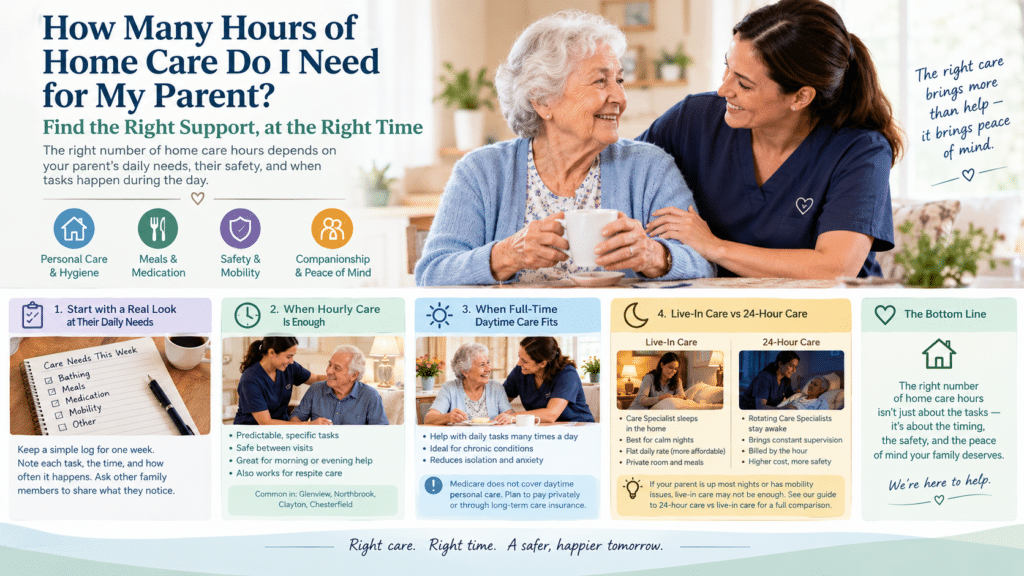
How Many Hours of Home Care Do I Need for My Parent?

Questions to Ask a Home Care Agency: A Comprehensive Guide

A home care aide talks with an older woman and her daughter as they review a care checklist at home.

Most families choose a home care agency in a hurry, often in the days after a fall or a hospital stay. The most useful questions to ask a home care agency cover four areas: the caregivers, the care plan, the cost, and how the agency keeps in touch. Print this checklist and use it on every call.

Asking the right questions early gives your family peace of mind and makes an important decision easier. A good way to compare agencies is to ask each one the same questions in the same order and write the answers down. Vague answers are red flags.

Home care options range from a few hours of help a week to around-the-clock care. Before you call, write down your parent’s care needs, the daily activities they struggle with, and the level of care you expect them to need next year. Share the list with other family members so the entire family agrees on what to ask.

Questions to ask a home care agency about caregivers

Start with the caregivers, because they are the people who will spend hours in your parent’s home and get to know their daily routine. These questions show how carefully they are chosen and trained.

  • Are your caregivers employees of the agency, or independent contractors?
  • What does your screening process include, and do you check state registries?
  • Do you check driving records for caregivers who drive clients?
  • How much care experience do new caregivers need before their first visit?
  • What training programs do caregivers complete, and is there ongoing training?
  • Do you have caregivers trained for specific needs, such as dementia care or Parkinson’s disease?
  • How does caregiver matching work, and does the matching process consider language and cultural background?

The first question is one of the most important questions on this list. When caregivers are employees, the agency handles their pay and payroll taxes and is responsible for supervising them on the job. When they are independent contractors, ask who covers insurance and backup care, because some of that may fall on your family.

Request references from two or three families who use the agency now, and read online reviews on more than one site. Reviews that mention the same caregiver for many months usually point to quality care. Complaints about missed visits deserve a direct question.

Questions to ask a home care agency about the care plan

A good care plan is written for one person. A personalized care plan lists the tasks the caregiver handles at each visit, such as personal care, meal preparation and help with activities of daily living like bathing. Ask who writes it and who keeps it up to date.

  • Do you offer an in-home assessment before care starts, and is there a fee?
  • Who writes the care plan, and how often is it reviewed as our family’s needs change?
  • How soon can care begin?
  • Will my parent have a regular caregiver, or a rotating team?
  • What backup plans cover caregiver absences, such as sickness or vacation?
  • Can you provide overnight, 24-hour home care or live-in care if needs grow?

Needs rarely stay the same for long. A parent who needs a few hours a week today may need daily help or overnight care after a fall or an illness. Continuity of care matters too, because seeing the same face helps your parent stay calm in familiar surroundings. Our guide to how many hours of home care a parent needs explains how families usually decide.

Questions to ask a home care agency about cost

Ask for every rate in writing before you sign anything. Home care is usually priced by the hour, while live-in care is often priced by the day, so make sure you compare the same kind of care between agencies. An agency with transparent pricing will send a full rate sheet without being asked twice.

  • What is the hourly rate, and is it different on nights, weekends or holidays?
  • Is there a minimum number of hours per visit or per week?
  • How much notice do you need to change or cancel a visit?
  • Do you require a deposit or a long-term contract?
  • What payment options do you accept, and do you work with long-term care insurance, VA benefits or Medicaid?

Medicare generally does not pay for non-medical home care, such as help with bathing or meals. If an agency suggests that Medicare will cover this kind of care, ask them to show you in writing which program pays and why.

Questions to ask a home care agency about safety and licensing

Rules for non-medical home care differ from state to state, so the same question can have a different right answer in Missouri, Kansas and Illinois. Ask what the agency holds. Then check it yourself with the state.

  • Which state license or registration do you hold, and can I see it?
  • Are you insured and bonded, and does the insurance cover caregivers in my parent’s home?
  • What quality standards do you follow, and who checks them?
  • Do care managers or supervisors visit the home to check on care?
  • Who do I call if something goes wrong or I have a complaint?
  • How do you handle an emergency during a shift?

Insurance protects your family if a caregiver is injured on the job or something is damaged in the home during a visit. A reputable agency shares proof of coverage when asked.

Questions to ask a home care agency about communication

Clear communication matters most when you live far away. Ask how you will hear about your parent between visits, and exactly who you can reach after hours or on a holiday weekend.

  • Who is my main contact, and how do I reach them?
  • Who answers the phone at night and on weekends?
  • How will you tell me about changes in my parent’s health or mood?
  • Can I give feedback about a caregiver, and how do you measure family satisfaction?

Home care or home health care?

Non-medical home care helps with daily life, while home health care is medical care given by healthcare professionals such as nurses and therapists. A doctor usually orders home health care after an illness or a hospital stay. Many families use both at once.

Ask each agency which care services it offers, so you know where its range of services ends. A non-medical agency should work alongside your parent’s doctors and other healthcare providers, and tell you when a need goes beyond what its home caregivers can do. Get that answer in writing.

How we answer these questions at Private Home Care

We think families should hold us to the same checklist we suggest for every other agency. Here are a few of our answers in plain terms.

Our caregivers are employed and supervised by Private Home Care. Each one goes through a virtual interview, identity and credential checks, a criminal background check, a driving record review and a Family Care Safety Registry check. They then attend an in-person orientation at their local office. Our post on how we vet our caregivers walks through every step.

Every plan starts with a complimentary in-home assessment, and we match caregivers to your parent’s personality, routine and care needs. Care can often begin within 24 to 48 hours when a family needs help fast, and more notice gives us time to build a steady team. Our office support team answers calls 24/7.

Families can also rate any caregiver at any time by scanning the QR code on the caregiver’s badge. If you are comparing agencies for in-home care for a parent, call (844) 785-2273 and ask us anything on this list.

Frequently asked questions

What does a home care agency do?

A home care agency hires and schedules caregivers who help older adults with daily life at home. Most non-medical senior care agencies help with bathing, dressing, meals, medication reminders and light housekeeping. The agency also covers shifts when a caregiver is out, so the home care service does not stop.

Do private caregivers need insurance?

Private caregivers should be covered by insurance, either through an agency or their own policy. When you hire a caregiver directly instead of through an agency, your family may be responsible for coverage and payroll taxes. Ask a tax adviser what applies.

Do home care agencies accept Medicaid?

Some home care agencies accept Medicaid, and many private-pay agencies do not. Medicaid home care programs are run by each state, and each one sets its own rules about which agencies can take part. Who qualifies depends on individual circumstances, so check with your state Medicaid office.

Use the checklist on every call

These questions to ask a home care agency also work as questions to ask a home health care agency. They turn a stressful search into a fair comparison of care providers and help you make an informed decision about quality home care. The best answers are specific and written down. The agency that answers clearly is usually the right home care provider for your parent.

,

How to Monitor Elderly Parents Living Alone (Without Cameras)

Understanding Sundowning Dementia: Evening Challenges

How Many Hours of Home Care Do I Need for My Parent?

Power Up Your Diet with Lion’s Mane

Are you looking to power up your diet? The Hieracium Erinaceus, also referred to as Lion’s Mane, is a delicious way to add an extra dose of health benefits to everyday meals! However, it is worth noting that while some promising research exists, more human trials are needed to substantiate these claims. Below are some of the benefits commonly attributed to Lion’s Mane:

Cognitive Enhancement

Several studies suggest that Lion’s Mane may promote nerve growth factor, which could benefit brain health. This has led to research on its potential to improve focus, memory, and other cognitive functions (Guan, et al. 2023). One small dietary addition could contribute to a healthier brain!

Neuroprotective Effects

Because of its potential to stimulate nerve growth factor, Lion’s Mane is being researched for its ability to slow or reverse cell degeneration in the brain, which is particularly important for diseases like Alzheimer’s and Parkinson’s (Guan, et al. 2023).

Mood Regulation

Some studies indicate that Lion’s Mane helps with symptoms of anxiety and depression, though the exact mechanisms are not fully understood.

Digestive Health

The mushroom has been used in traditional medicine for improving digestive health. It is thought to have anti-inflammatory properties that could benefit the gut.

Anti-Cancer Properties

Some research in animal studies suggests that Lion’s Mane has anti-cancer properties, particularly against certain types of leukemia and gastric cancers (Loizzo 2021).

Immune System Support

Though not as well-studied as other areas, some evidence suggests that Lion’s Mane can boost the immune system by increasing the activity of specific white blood cells.

Anti-Aging

Some proponents believe that its antioxidant properties can offer anti-aging benefits, although this is less substantiated by scientific evidence.

Always consult healthcare providers before starting any new supplement or embarking on a new dietary journey, especially if you have pre-existing conditions or are taking other medications.

Looking for a recipe to try? Let Real Mushrooms inspire you!

References

Guan, Y., Shi, D., Wang, S., Sun, Y., Song, W., Liu, S., & Wang, C. (2023). Hericium coralloides Ameliorates Alzheimer’s Disease Pathologies and Cognitive Disorders by Activating Nrf2 Signaling and Regulating Gut Microbiota. Nutrients, 15(17), 3799. https://doi.org/10.3390/nu15173799

Loizzo, Sanches-Silva, A. T., Loizzo, M. R., & Sanches-Silva, A. T. (2021). Natural Antioxidants: Innovative Extraction and Application in Foods. MDPI – Multidisciplinary Digital Publishing Institute.

,

How to Monitor Elderly Parents Living Alone (Without Cameras)

,

Questions to Ask a Home Care Agency: A Comprehensive Guide

Understanding Sundowning Dementia: Evening Challenges