

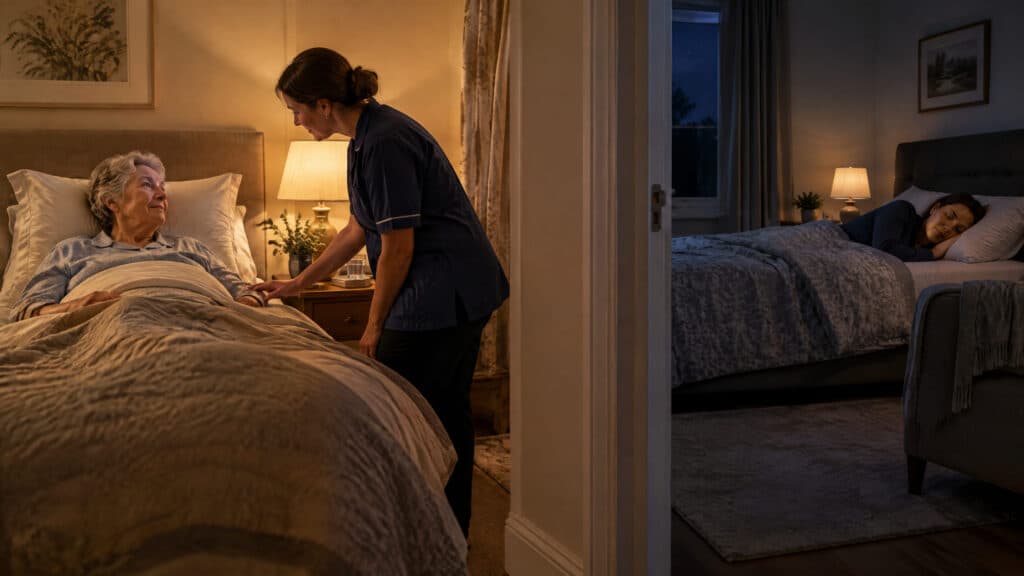
When one daytime Care Specialist is no longer enough, families start hearing two options that sound the same but work very differently: 24-hour care and live-in care. Both keep someone in the home overnight, and both are non-medical. The real question is whether that person is awake at 3 a.m., and the answer changes the staffing, the cost, and who each setup is right for.
Here is how 24-hour care vs live-in care actually breaks down, so you can match the right arrangement to what your parent needs after dark.
What Is Live-In Care?
Live-in care means one or two Care Specialists stay in the home for a stretch of days at a time, share the daily routine, and sleep there overnight. The Care Specialist gets a private bedroom, meals, and a set sleep period of around eight hours, plus a break during the day. Because someone is present rather than working every single hour, this option is billed at a flat daily rate.
It fits medically stable seniors who sleep through most nights but should not be alone during the day. Daytime support covers meals, light housekeeping, medication reminders, and help with activities of daily living, along with steady company. You also get consistency, since one or two familiar faces build a real relationship with your parent rather than a rotating cast of different people, which matters greatly for comfort and quality of life.
The trade-off is honest: for the hours the Care Specialist is asleep, your parent is largely on their own, so this only works when the nights are calm.
What Is 24-Hour Care?
24-hour care means two or three Care Specialists work rotating shifts, usually eight or twelve hours each, and every one of them stays fully awake and on duty. Nobody sleeps on the clock, so you get continuous supervision at every hour, including the middle of the night. Because you are paying for active, awake coverage the whole time, it is billed hourly and costs more.
This is the right call when the nights are the problem. Awake supervision around the clock is what your parent needs if they wander, need frequent repositioning through the night, are recovering from surgery or a hospital stay, or have advanced dementia and medical needs that do not pause at bedtime.
The One Difference That Matters
Strip away everything else and one thing separates them: at 3 a.m., is the Care Specialist awake or asleep? With 24-hour home care, someone is awake all night. With a live-in arrangement, the Care Specialist is asleep for roughly eight hours and wakes only if needed. Both are forms of in-home care, but cost, staffing, and home requirements all flow from that single fact about nighttime safety.
Live-In Care
- Care Specialists: 1 to 2, several days at a time
- Overnight: Care Specialist sleeps, wakes if needed
- Billing: flat daily rate
- Home needs: private bedroom and meals required
- Best for: stable nights, daytime help and companionship
24-Hour Care
- Care Specialists: 2 to 3 rotating in shifts
- Overnight: Care Specialist stays fully awake
- Billing: hourly, higher total cost
- Home needs: no special requirements
- Best for: night risk, wandering, complex or changing needs
Which One Does My Parent Need?
Answer one question first: what happens overnight? If your parent sleeps through the night and mainly needs daytime support, company, and a presence in case something comes up, a live-in arrangement usually fits and costs far less. If they are up at night, unsteady, dealing with mobility issues, wandering, or needing regular attention after dark, awake shift coverage is the safest option.
A parent who nods off by eight and sleeps until morning is a very different situation from one who is up and calling out three times a night. Be honest about the nights, because this is where families most often guess wrong. Picking the cheaper option for a parent who truly needs overnight supervision puts them at real risk in practice. A good Care Coordinator reassesses regularly rather than locking you into one arrangement.
What Does Each Option Cost?
When you compare 24-hour care vs live-in care on price, the gap is large and predictable. A live-in arrangement runs at a flat daily rate and is the more budget-friendly of the two, because the Care Specialist is present rather than clocking active hours all night. Awake coverage is billed hourly across every shift and commonly costs close to double. The real figure depends on the hours, the level of support, and your area.
Frequently Asked Questions
Does the live-in Care Specialist really sleep at night?
Yes. In this setup the Care Specialist gets a set sleep period, usually around eight hours, in a private bedroom. They wake to help if your parent needs them, but they are not on active duty all night. If your parent is up and needs help most nights, that broken sleep is a sign you may have moved past what a live-in setup can safely handle.
How do I choose between 24-hour care and live-in care?
Track a week of nights. Count how often your parent is actually up and needs hands-on help after bedtime. Steady, quiet nights favor a live-in arrangement. Frequent night needs, wandering, or medical tasks point to awake shifts.
Can we switch between them?
Yes. Many families start with one arrangement and change as their parent’s needs change. Someone may need awake overnight coverage right after surgery, then step down to live-in care as they get stronger.
Getting It Right
Getting 24-hour care vs live-in care right comes down to one honest question about the nights. If the nights are calm, a live-in arrangement gives your parent steady, one-on-one support in their own home at a far lower cost. If the nights carry real risk, awake shift coverage is the safest option.
Private Home Care helps families across Chicago, Glenview, Northbrook, Wilmette, Evanston, Skokie, Park Ridge, St. Louis, and Kansas City weigh both options, right down to a week-by-week look at what the nights actually require. Call (847) 779-3352 to speak with a Care Coordinator, or request a complimentary in-home assessment at privatehomecare.com.