
Introduction
Talking with a loved one who has dementia can become emotionally challenging for families.
Conversations that once felt natural may suddenly involve confusion, memory loss, repeated questions, mood changes, or frustration.
Many family caregivers struggle with knowing what to say. or how to respond when communication becomes difficult.
The good news is that small changes in communication style can make a meaningful difference.
Speaking calmly, clearly, and compassionately can help reduce anxiety, prevent arguments, and create more positive daily interactions.
Understanding how dementia affects communication can help families support their loved one with greater patience, confidence, and empathy.
Why Communication Changes With Dementia?
Dementia affects the brain in ways that gradually affect memory, language, reasoning, and emotional processing.
As dementia progresses, a person may have difficulty:
- Finding the right words
- Following conversations
- Remembering recent information
- Understanding complex instructions
- Recognizing familiar people
- Expressing emotions clearly
These communication challenges are not intentional. Your loved one is not trying to be difficult or uncooperative.
They are navigating changes in the brain that affect how they understand and respond to the world around them.
The Importance of Compassionate Communication
The way caregivers communicate can significantly affect a senior’s emotional well-being.
Positive communication can help:
- Reduce confusion and agitation
- Build trust and comfort
- Lower anxiety
- Prevent arguments
- Encourage cooperation
- Preserve dignity
Even when memory fades, emotions often remain strong. Seniors with dementia may not remember specific words or events, but they often remember how interactions made them feel.
Tips for Speaking to Someone With Dementia
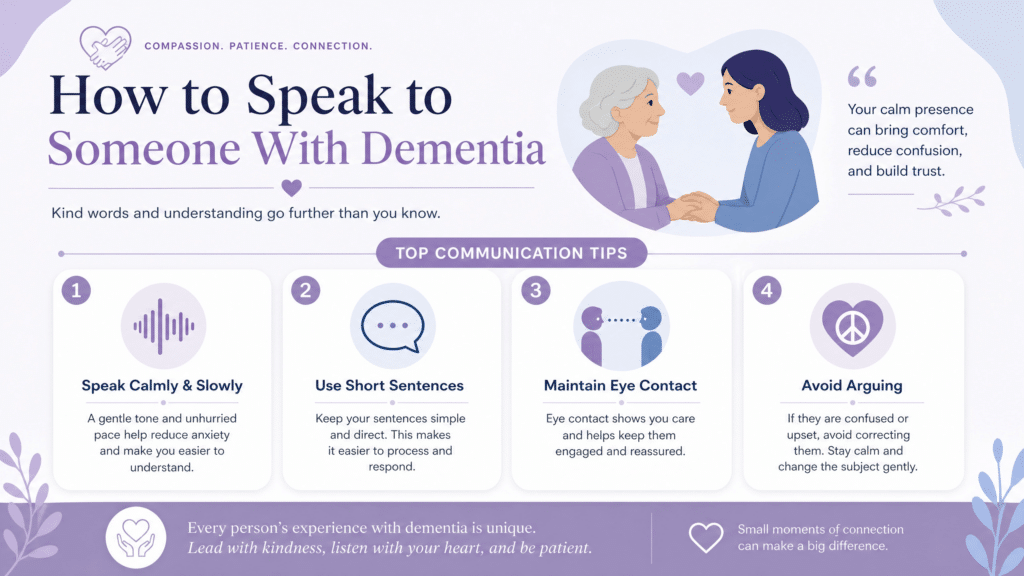
Speak Calmly and Slowly
Use a gentle tone of voice and speak at a slower pace.
Avoid rushing conversations or speaking too loudly unless hearing loss is involved.
Simple, calm communication helps reduce stress and makes it easier for the person to process information.
Use Short, Clear Sentences
Giving long explanations or multiple instructions at once can feel overwhelming.
Instead of saying:
“After breakfast we’re going to take your medication, get dressed, and leave for your doctor’s appointment.”
Try:
“Let’s finish breakfast first.”
Then move to the next step calmly.
Breaking tasks into smaller steps helps reduce confusion.
Avoid Correcting or Arguing
It can be tempting to correct inaccurate memories or repeated statements, but arguing often increases frustration and distress.
If a loved one says something incorrect, it is usually better to redirect the conversation gently rather than insist on facts.
For example, instead of saying:
“No, that happened years ago.”
You might say:
“That sounds important to you. Tell me more about it.”
Validation can help the person feel heard and emotionally safe.
Maintain Eye Contact
Approach the person calmly from the front and maintain soft eye contact while speaking.
Nonverbal communication plays a major role in dementia care.
A warm facial expression, relaxed posture, and reassuring touch can help someone feel secure even when they struggle to understand words.
Limit Distractions
Background noise can make conversations more confusing.
Try reducing distractions such as:
- Television
- Loud music
- Multiple conversations
- Crowded environments
Quiet spaces often improve focus and reduce overstimulation.
Ask Simple Questions
Open-ended questions can feel overwhelming.
Instead of asking:
“What would you like to wear today?”
Try offering simple choices:
“Would you like the blue shirt or the green shirt?”
Too many options may increase anxiety or confusion.
Be Patient with Repeated Questions
Repetition is common with dementia.
Although answering the same question repeatedly can feel exhausting, frustration may worsen the situation.
Responding calmly and reassuringly, helps maintain emotional stability.
Sometimes the repeated question reflects anxiety, fear, or a need for reassurance rather than a search for information.
What Not to Say to Someone With Dementia
Certain phrases may unintentionally increase confusion or emotional distress.
Try to avoid statements like:
- “I already told you that.”
- “You’re wrong.”
- “Don’t you remember?”
- “That never happened.”
- “You just asked me that.”
These responses may cause embarrassment, frustration, or fear.
Instead, focus on reassurance, redirection, and emotional comfort.
How Professional Caregivers Help With Dementia Communication
Professional dementia caregivers are trained to communicate in ways that reduce stress and support emotional well-being.
Caregivers often use techniques such as:
- Validation therapy
- Gentle redirection
- Calm reassurance
- Routine-based communication
- Structured daily interactions
At Private Home Care, caregivers provide compassionate one-on-one support designed to help seniors with dementia feel safe, respected, and understood at home.
When Communication Becomes More Difficult
As dementia progresses, verbal communication may become increasingly limited.
Families may notice:
- Difficulty recognizing loved ones
- Increased confusion
- Nonverbal communication
- Emotional withdrawal
- Agitation or frustration
During later stages, comfort, tone of voice, and emotional reassurance often become more important than the exact words being spoken.
Simple presence and compassionate support can provide tremendous comfort.
Caring for Yourself as a Family Caregiver
Supporting someone with dementia can be emotionally exhausting.
Family caregivers should remember that communication challenges are part of the disease process, not a personal failure.
It is important to:
- Take breaks when needed
- Seek emotional support
- Ask for professional help
- Practice patience with yourself
- Accept that difficult days will happen
Respite care and professional home care services can provide families with valuable support and relief.
Frequently Asked Questions
What is the best way to talk to someone with dementia?
Speak slowly, use short sentences, maintain a calm tone, and avoid arguing or correcting the person unnecessarily.
Why do dementia patients repeat themselves?
Memory loss caused by dementia often prevents the person from remembering previous conversations or answers.
Should you correct someone with dementia?
In many situations, correcting someone may increase frustration or anxiety. Gentle redirection and reassurance are often more effective.
Why does dementia affect communication?
Dementia changes areas of the brain responsible for memory, language, reasoning, and understanding.
Can professional caregivers help with dementia communication?
Yes. Professional caregivers are trained in dementia communication techniques that help reduce confusion, agitation, and emotional distress.
Conclusion
Caring for a loved one with dementia can feel overwhelming, but compassionate support can make daily life easier for both seniors and families.
At Private Home Care, our experienced caregivers provide personalized dementia care focused on safety, comfort, companionship, and respectful communication.