

If someone you love has been diagnosed with Alzheimer’s or dementia, one of the first decisions families in Glenview, Wilmette, Northbrook, Evanston, and across the Chicago north suburbs face is whether to keep their loved one at home or move them to a memory care facility.
There is no single right answer. The right choice depends on your loved one’s current stage of dementia, their living situation, your family’s capacity to support them, and what matters most to the person at the center of this decision. This guide is meant to help you think through that honestly, not to push you toward any particular outcome.
What In-Home Dementia Care Looks Like
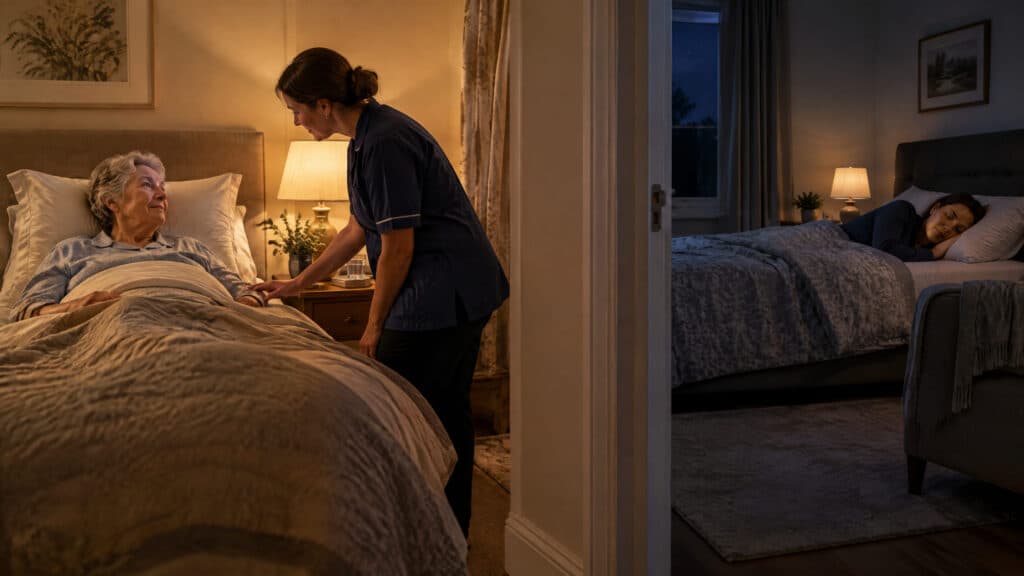
In-home dementia care means a trained Care Specialist comes to your loved one’s home on a scheduled basis, or lives with them full time in the case of live-in care, and provides support within the environment your loved one already knows.
For many people in the early to middle stages of dementia, familiar surroundings, their own furniture, their own neighborhood, their own routines, are genuinely stabilizing. Disorientation often increases when a person with dementia moves to a new environment. Staying home, with the right support, can preserve a sense of normalcy and reduce anxiety.
What Works Well With In-Home Care
- Early to moderate stages of Alzheimer’s or dementia.
- A safe home environment that can be adapted as needed.
- A consistent Care Specialist who builds a real relationship with the client.
- Family members who want to stay closely involved in daily care decisions.
- A loved one who has expressed a clear preference to stay home.
Where In-Home Care Has Limits
- Advanced dementia with significant safety risks that a home environment cannot address.
- Medical needs that require 24-hour clinical oversight.
- A family caregiver who has reached the point of exhaustion with no relief in sight.
- A loved one who is isolated at home and would benefit from social engagement in a group setting.
What Memory Care Facilities Provide
Memory care facilities are specialized wings within assisted living communities, designed specifically for people with Alzheimer’s and dementia. They offer structured programming, a secure environment, and staff trained in dementia care available around the clock.
For families whose loved one has progressed to a stage where consistent in-home care is no longer sufficient to keep them safe, or where the family caregiving system has reached a breaking point, a memory care facility can provide a level of supervision and structured programming that home care cannot.
The Questions That Actually Help Families Decide
Rather than comparing lists of features, the families we work with across Glenview, Wilmette, Northbrook, and Evanston often find it more useful to sit with these questions:
- What does our loved one want, and how clearly have we asked them?
- What stage of dementia are we dealing with today, and what does the trajectory look like?
- Is the home environment safe, or would it require significant modification?
- Who in our family is currently providing care, and what is the realistic cost to them?
- Have we actually tried structured in-home care, or are we making this decision without that information?
A Word on Timing
One of the most common things we hear from families who chose in-home care is that they wish they had started sooner. Not because the situation was an emergency, but because having a consistent Care Specialist in place before things became difficult gave their loved one time to adjust, build a relationship with the caregiver, and maintain more of their independence for longer.
The families who move directly to a facility without trying in-home care sometimes discover later that their loved one could have stayed home safely for longer with the right support. That is not always the case, but it is worth knowing before a decision is made.
How Private Home Care Supports Families Across the Chicago North Shore
Private Home Care provides in-home Alzheimer’s care for families throughout Glenview, Wilmette, Northbrook, Evanston, Skokie, Park Ridge, and the surrounding Chicago north suburbs. Our Care Coordinators are available 24/7, and every client is matched with a consistent Care Specialist trained in memory care support.
If you are in the middle of this decision, we are happy to have an honest conversation about whether in-home care is the right fit for your family’s situation, without any pressure toward a particular outcome. We would rather help you make the right decision for your loved one than the one that happens to work for us.
Call (847) 779-3352 to speak with a Care Coordinator, or request a complimentary in-home assessment at privatehomecare.com.